
New Orleans Klezmer All Stars / The Big Kibosh
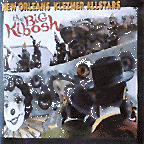
New Orleans Klezmer Allstars
The Big Kibosh
Shanachie Records 6026, 1997
From the opening chords of their first album; from the opening notes of any concert on any stage, no matter how small, the New Orleans Klezmer Allstars have been defining a frenetic, dance-compelling fusion of klezmer and New Orleans funk and rock 'n' roll for years. This is crossover klezmer and New Orleans proving, irresistably and irrefragably, how essential both qualities, like red beans and rice, are to each other. I once quibbled that the parts were not quite integrated. On this new album, it all comes together in their best recorded effort yet.
The album opens with a Germanic "eins zwei drei" and a literal wake-up call, a niagara falls-generated speed klez shot in the head. They don't actually slow down until they reach mere "fast" in the following freilach, and even the thoughtful "Chaye!," or the later "Lullaby" still maintain that intensity. On the other hand, the funky riffs of "Klip Klop" remind me intensely of Naftule's Dream, here pulled back from funk by absolutely delicious krechts on the clarinet and periodic trips into pure simkha dance--not to mention a ringing phone that makes no sense but for the fact that it fits and introduces a wonderful cantorial plea. "Klip Klop" illustrates that perfect NOKAS speciality: the flip back and forth between funk and klez, all the while ensuring that there is no living option but moving to the music. This will come up again and again, as, for instance, on the perfect breaks of "Di Zilberne Chasene" (the guitar picking is my fave, here), and despite the fact that, for NOKAS, the rest of the "Wedding Suite" is closer to traditional klezmer in speed and style (if not in the wonderful sax). Another delightful fusion is a syncopated "Palestina" dominated by accordion and percussion, joined periodically by the crying, klezmer clarinet. That is almost the only time on the album that the band feels truly relaxed, except for the the final cut on the album, "bweep bweep," a full quarter of an hour of klezmer funk jam, demonstrating definitively how all of this comes together for an extended session on the dance floor (and not without its own surprising moments).
I like to tell the story of God, sitting in the heavens, eagerly awaiting new music, finally able to exclaim to those around her, "at last I can hear it live!" This music is one of those that she has awaited since creation.
In one of the album's samples, someone says, speaking about the band, "it's not Jewish enough." On the contrary, this is what happens when "Jewish" moves past medieval stereotypes (or that frozen space before we all assimilated and moved to Scarsdale where we bought big cars and all became doctors and lawyers except for those damn communists and socialists, about whom will shall not speak, hah!) and into the next century. "The Big Kibosh" is Jewish for the next "meya". It's also music enough to move those out there who are stuck in the memories of klezmer that was, or have heretofore been deprived of any form of "Jewish" whatsoever. To paraphrase an early poem by Yehuda Amichai, it is understandable that, having moved beyond the edges of the field, the band should come spilling forth into the world and past normative boundaries of "this is klez" and "that is funk".
Reviewed by Ari Davidow, 12/2/97
Personnel this recording:
Ben Ellman: soprano & tenor saxophones, tambourine
Robert Wagner: clarinet, bass clarinet, percussion
Rick Perles: violin
Glenn Hartman: accordion, piano, organ, toy piano, prepared piano
Jonathan Freilich: acoustic & electric guitars, sleigh bells
Arthur Kastler: acoustic & electric bass, slide whistle, bicycle horn, etc.
Stanton Moore: drums on 3, 6, 7, 10, 11, 12, 13, 15
Kevin O'Day: drums on 1, 2, 4, 5, 8, 9, 15
Cantor Steven Kubov: vocals on 4 ("Klip Klop")
Songs
- The Wake Up Call (Glenn Hartman) 0:57
- A Viennese Freilach (Robert Wagner) 3:28
- Chaye! (Jonathan Freilich) 3:45
- Klip Klop (Robert Wagner) 5:26
- Lullaby (Glenn Hartman) 6:40
- Di Zilberne Chasene--The Silver Wedding (trad., arr. NOKAS) 5:01
- Transition to Buffet (Robert Wagner) 4:04
- Taking the flower arrangements home after the wedding (Jonathan Freilich) 3:08
- D'Bronz Tantz (Arthur Kastler) 3:05
- Palestina (trad., arr. NOKAS) 2:49
- This one ... (Robert Wagner) 1:03
- The Trio (Jonathan Freilich) 4:29
- ... Goes to Eleven (Robert Wagner) 1:39
- Bob's Birthday Song (Jonathan Freilich) 2:36
- Bweep, Bweep (trad., arr. NOKAS) 16:29
The Wedding Suite


